
CaseScan Performance Benchmarks
CaseScan detects CSAM and other harmful content for content platforms and 100+ law enforcement agencies, including the FBI and HSI. Here's how it performs in production.
Last updated: August 2026
Request a DemoFor Trust & Safety Teams
Content platforms and Trust & Safety teams are past the point where "we run a filter" is an acceptable answer to regulators. The numbers below are the ones auditors, counsel, and your own engineers will ask for: detection performance by operating profile, false-positive rates measured on production traffic, and a retention posture that keeps scanned media out of CaseScan's persistent storage entirely.
Detection Performance By Operating Profile
| Operating profile | Recall (lab-measured) | False-positive rate (production, general-image traffic) | Designed for |
|---|---|---|---|
| High Coverage | 95.48% | ~1 per 76,000 images | Maximum detection coverage, with a moderation team reviewing flagged content |
| Balanced | 85.93% | ~1 per 1.9 million images | Broad coverage with limited review capacity |
| Autonomous Maximum Precision | 69.34% | 1 per 45 million images | Fully automated enforcement without human review |
Recall figures are lab-measured against curated evaluation sets. False-positive rates are derived from production general-image traffic, the most realistic predictor of real-world performance. At the base detection threshold, the general-traffic false-positive rate is approximately 1 in 680,000. Benchmarks on pre-flagged queues and lab stress tests read worse by design, because those datasets concentrate borderline content. Many vendors quote one number without saying which environment it came from. CaseScan publishes all three.
Account-Level Detection
An account holding prohibited material rarely holds a single file. At 69.34% single-image recall, the probability of flagging at least one of five offending files on an account is 99.7%. This is a statistical projection, not a measured result.
Built For Traffic Spikes
Cloud-native, stateless, and auto-scaling. Throughput holds above 2 billion files per day with no degradation under traffic spikes, at P95 latency under one second end to end.
Beyond CSAM
One API covers multiple harm categories: narcotics and weapons, graphic violence, and ID and fraud documents, alongside CSAM detection. One vendor, one integration, one consistent confidence scale across every queue.
Zero Media Retention
Scanned files are processed in volatile memory and never written to disk. This eliminates persistent storage of scanned media, reducing storage attack surface and data-retention exposure.
Compliance, Documented
A compliance dashboard with exportable evidence kits, aligned to NCMEC CyberTipline reporting requirements. CaseScan is an Internet Watch Foundation member, and the platform is built with REPORT Act and EU Digital Services Act obligations in mind.
Trusted by content platforms and partners including:



For Law Enforcement
Every hour spent manually reviewing seized media is an hour a child waits. These are the numbers that matter in the field: how fast triage runs, where it can run, and whether the output stands up in court.
Under 5 Minutes On Scene
Triage a suspect device at the scene and surface probable CSAM in under 5 minutes, fast enough to support on-site arrest decisions.
Air-Gapped By Design
Real-time analysis even on full 256GB+ devices. No network connection required, no data leaving the room, fully offline processing keeps evidence local throughout analysis.
Court-Ready Output
Evidence exports include an audit trail and chain-of-custody documentation.
Built For Investigator Wellness
Integrated blurring reduces direct exposure to traumatic material during review, protecting the people who do this work.
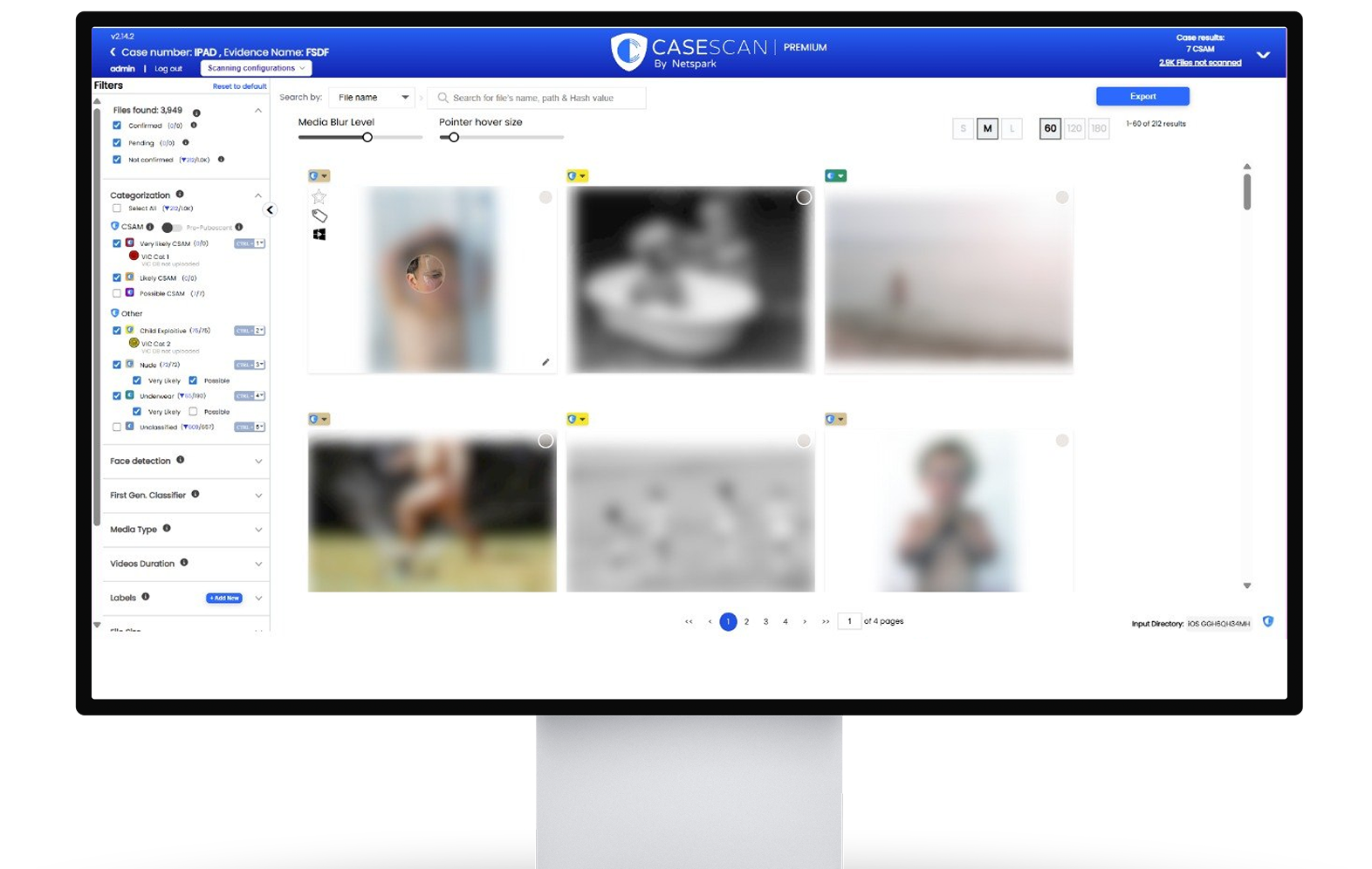
The CaseScan triage dashboard: filters, blur controls, and evidence export.
More than 100 agencies work with CaseScan, including the FBI and HSI.







Frequently Asked Questions
What is CaseScan's false-positive rate?
It depends on the operating profile, and CaseScan publishes all of them. In Autonomous Maximum Precision mode, the production false-positive rate is 1 per 45 million images at 69.34% recall. The Balanced profile runs at roughly 1 per 1.9 million images at 85.93% recall, and High Coverage at roughly 1 per 76,000 images at 95.48% recall. At the base detection threshold on general-image traffic, the rate is approximately 1 in 680,000.
How many files can CaseScan process per day?
More than 2 billion. The platform is cloud-native, stateless, and auto-scaling, so throughput holds during traffic spikes without added latency.
Does CaseScan store scanned images?
No. CaseScan operates with Zero Media Retention: files are processed in volatile memory and never written to disk, so no scanned media persists anywhere in the system.
How fast is CaseScan's detection?
End-to-end API latency for single-frame image analysis is under 1 second at the 95th percentile and under 2 seconds at the 99th. For law enforcement, on-scene triage of a seized device returns prioritized findings in under 5 minutes, fully offline.
What can CaseScan detect beyond CSAM?
Narcotics and weapons, graphic violence, and ID and fraud documents, through the same API and the same confidence scale used for CSAM detection.